Kenya Ebola Facility Sparks Massive Protests in Laikipia
Rada Safi News June 2, 2026 0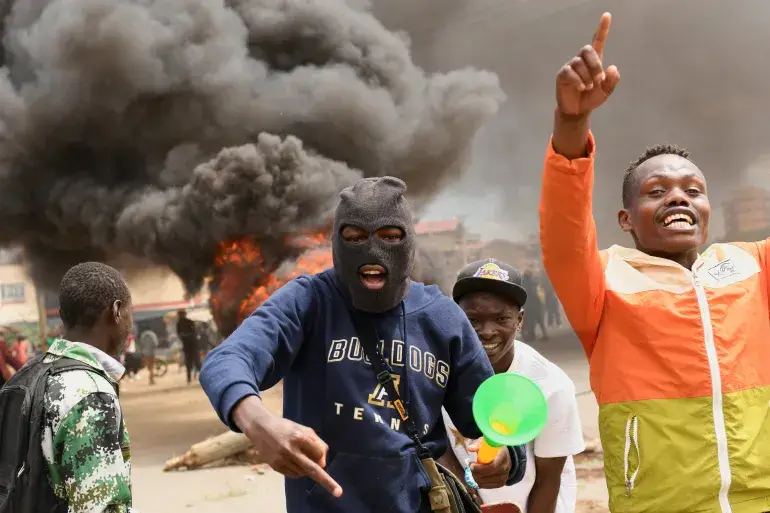
PesaSpin Kenya
Spin & Win Real Cash Directly to M-Pesa — Kenya's #1 Online Spin Game 2026
Close this offer · 5s
Hundreds Protest US-Backed Ebola Facility in Kenya as Nanyuki Residents Reject Quarantine Plan
June 2 court hearing underway. Kenya's government reportedly pushing ahead with facility plans despite High Court conservatory orders.
Hundreds of residents in Nanyuki, central Kenya, took to the streets on Monday, June 1, 2026, to protest a US-backed Ebola quarantine facility planned for Laikipia Air Base — a Kenya Air Force installation located roughly 8 km west of the town. The demonstrations came just days after Kenya's High Court issued emergency orders suspending the project, yet anger on the ground showed no signs of abating. The growing standoff has exposed deep fault lines between public health diplomacy, national sovereignty, and community fears in one of Kenya's most scenic highland towns.
Background: The Proposed Kenya Ebola Facility
The controversy began when international media reports revealed that the US government had secured Kenya's approval to establish a 50-bed Ebola quarantine and isolation facility at Laikipia Air Base, approximately 200 km north of Nairobi.
A 50-bed Ebola isolation unit, built by the US military and staffed by US Public Health Service officers, to monitor asymptomatic Americans exposed to Ebola in the DRC or Uganda — instead of flying them home.
The US pledged $13.5 million toward Kenya's Ebola preparedness, plus $112 million already committed to the broader regional response — discussed by Secretary Rubio and President William Ruto directly.
No public disclosure of the arrangement was made before media reports surfaced, triggering a swift and fierce backlash from residents, civil society, and the medical community.
Why Residents Are Protesting the Ebola Quarantine Center
For Nanyuki residents, the proposal raises far more questions than it answers. The central grievance is straightforward: Kenya has recorded zero confirmed Ebola cases, yet it has been asked to serve as a holding facility for infected or exposed foreign nationals from a disease ravaging communities more than 1,500 miles away.
"As residents of Nanyuki, we have said we do not want that Ebola rescue centre in Nanyuki. And it's not just Nanyuki — we don't want it in Laikipia, and not just Laikipia — we don't want it in Kenya.
— MP Sarah Korere, Laikipia County
The Kenya Medical Practitioners, Pharmacists and Dentists Union (KMPDU) put that argument in stark terms: "We will not sit back and watch Kenya be treated as a containment colony for a lethal pathogen that we did not generate. If it is too dangerous for America, it is too dangerous for Kenya."
Details of the Nanyuki Protests
On the morning of Monday, June 1, 2026, hundreds of demonstrators — many of them young people — gathered in Nanyuki town and began marching toward Laikipia Air Base. Protesters blew whistles, chanted slogans, lit bonfires, and erected burning barricades on roads leading to the base. Kenya Defence Forces soldiers sealed off the perimeter entirely, blocking all access.
Kenyan Government's Response
The Kenyan government's response has been conspicuously muted — and that silence has itself become part of the controversy. Health CS Aden Duale cited Kenya's surveillance capacity and border systems, but did not address the core grievance: that a facility designed primarily for foreign nationals was established on Kenyan soil without adequate public consultation or parliamentary approval.
Secretary Rubio confirmed direct discussions with President Ruto on Ebola preparedness and US financial commitments. Both agreed to "maintain close coordination as the situation evolves."
No official statement explained the terms, legal basis, or community safeguards. CNN reported the government appeared to be pushing ahead despite the court order — deepening public suspicion.
President William Ruto's Position on the Ebola Facility
President William Ruto's handling of the controversy has drawn sharp criticism. The arrangement was negotiated at the highest levels — yet when public backlash erupted, the administration declined to publicly defend the deal. This silence is widely interpreted as the government being caught flat-footed by the speed and intensity of the opposition.
For a president whose popularity has been tested since the violent suppression of youth-led protests in 2024, the optics of Kenya appearing to accommodate US interests at the expense of ordinary citizens is politically fraught territory.
Court Ruling and Legal Challenges
On Friday, May 29, 2026 — reportedly the very day the facility was set to begin operating — High Court Judge Patricia Nyaundi issued sweeping conservatory orders that froze the entire plan. Petitions were filed by the Law Society of Kenya (LSK) and the Katiba Institute.
High Court Conservatory Orders — What Is Blocked
- Establishing, operationalising, facilitating, approving, or permitting any Ebola quarantine, isolation, or treatment facility under any US or foreign government arrangement.
- Admitting into Kenya, transferring to Kenya, or facilitating the entry of persons exposed to or infected with Ebola under the disputed arrangement.
Petitioners: Law Society of Kenya (LSK) & Katiba Institute · Next hearing: June 2, 2026
Public Health Experts' Opinions
Independent health analysts point to a critical disconnect: the facility was designed primarily to serve US citizens, not Kenyan patients or East African communities bearing the brunt of the outbreak. With over 263 confirmed cases of the Bundibugyo strain of Ebola in the DRC and Uganda and at least 200 deaths, the epicentre is far from Laikipia.
"A well-resourced US-funded isolation unit could enhance Kenya's outbreak response capacity — but the lack of transparent safety protocols and public consultation is itself a public health risk, one that erodes the community trust necessary to mount effective outbreak responses.
— Independent Public Health Analyst
Impact on Local Communities and Businesses
For Nanyuki — a gateway town to Mount Kenya, Ol Pejeta Conservancy, and the Laikipia Plateau — the reputational stakes are high. The town's economy is closely tied to wildlife tourism, with safari operators, lodges, and conservancies dependent on perceptions of safety. The mere association with an Ebola facility risks deterring tourists and investors.
Communities near outbreak response facilities have historically faced discrimination — a phenomenon documented in West Africa's 2014–2016 Ebola crisis, where entire regions were shunned by outsiders despite having low or zero transmission rates.
International Reactions and US–Kenya Relations
The US Foreign Service stated on May 29: "We are aware of the court action filed in Kenya against the Ebola isolation facility. We are in touch with Kenyan authorities and are optimistic we can resolve objections."
A new bilateral health agreement provides $1.6 billion from 2026–2030 — but with Kenya bearing more of its own health financing, representing roughly $423 million less than previous US funding levels. The Ebola facility controversy has hardened opposition to the broader arrangement.
What Happens Next?
With the court hearing on June 2 and protests ongoing, the coming days are likely to be decisive. Three scenarios are possible:
Court upholds suspension
Forces the government to formally abandon or significantly renegotiate the facility arrangement — a major legal and diplomatic setback for both Nairobi and Washington.
Government appeals or modifies terms
Proposes a revised facility with transparent governance, community benefits, and an entirely different location farther from populated areas.
Political compromise reached
President Ruto uses Kenya's leverage to secure more favourable health funding terms in exchange for a path forward on the facility — but this requires public buy-in that currently does not exist.
Conclusion: A Crisis at the Intersection of Health, Sovereignty, and Trust
The controversy surrounding the Kenya Ebola facility is ultimately about more than a 50-bed isolation unit at a military base. It is about who gets to make decisions that affect communities, and whether the relationship between Kenya and its international partners is genuinely equitable.
"Why should a country with zero Ebola cases shoulder the risks and reputational costs of managing an outbreak that originated elsewhere — and primarily for the benefit of foreign nationals?
— Public health advocates, civil society, Nanyuki residents
As the courts weigh in, protests continue, and diplomats negotiate behind closed doors, one thing is clear: the residents of Nanyuki are watching closely, and they will not be ignored.